
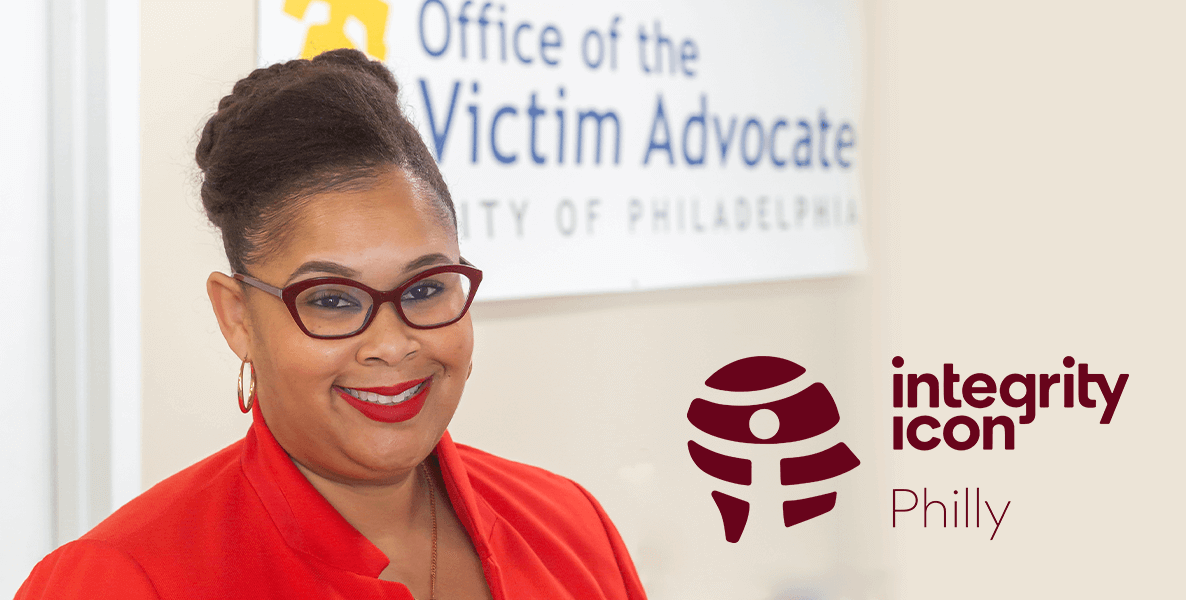
The first-ever director of Philly’s Office of Victim Advocate has parlayed a decade in the DA’s office to bring dignity and much-needed help to victims and their communities
Working at the District Attorney’s Office for 11 years will teach you a lot about the resources that exist — and don’t — for victims of gun violence in Philadelphia. Adara Combs can speak to the personal side of crime as well. “The prosecution is just one chapter in the victim or co-victim’s story,” Combs says. “The journey through healing from being a victim of crime is honestly a lifelong journey from the moment it happens until forever.”
On the day she resigned from the DA in January 2022, to accept a position as the City’s first-ever executive director of the Office of Victim Advocate, Combs got a phone call letting her know that her cousin had been shot and killed in Frankford. It wasn’t the first time she endured a tragic encounter with crime via a family member. When Adara was a child, her mother was robbed at gunpoint around the corner from their home. “I grew up in Philadelphia,” says Combs, who was raised in the Mount Airy and West Oak Lane neighborhoods. “Unfortunately, statistically, that means you are more likely than not to be touched by crime and violence.”
Possessing a deep well of both professional and personal experiences has benefitted Combs in her leadership of an upstart government office. Only two years after Combs’ confirmation by City Council, Philadelphia’s Office of the Victim Advocate has already carved out a role as a connector and leader in the push to improve victim services at a time when we more clearly understand the links between victimization and perpetration of crime.
“The prosecution is just one chapter in the victim or co-victim’s story. The journey through healing from being a victim of crime is honestly a lifelong journey from the moment it happens until forever.”
In this light, the patchwork of programs and organizations which provide services to victims across the city is not only about those victimized — but about public safety writ large. “I think I come to this from a very unique lens in the sense that I understand that intersectionality,” says Combs.
For her accessibility and innovation, her holistic approach to justice that makes victims feel seen and cared for, Combs is one of The Citizen’s 2024 Integrity Icons, awarded to city workers who go above and beyond their job descriptions to serve city residents. Along with the other four Icons, Combs will be honored at a party at Fitler Club on May 23. See the other winners here.
What is an Integrity Icon?
In partnership with DC-based Accountability Lab, The Citizen is the only American city to run an Integrity Icon program. The goal: To name and fame the city workers going above and beyond to make a positive impact in Philadelphia.
This past spring, the public nominated dozens of excellent city workers for the award, using the following criteria: They are a high-integrity public service employee who is respectful and caring; know their work makes a difference to people’s lives; act in a trustworthy and transparent way to solve problems the best they can; treat everyone equally, without regard to politics or influence; and go above and beyond to provide good service to Philadelphians.
A panel of high-integrity judges reviewed the candidates, and selected this year’s honorees. The 2024 winners join 15 other Integrity Icons named by The Citizen since 2021. Read about the others here.
Big picture ideas
For victims and loved ones, navigating the decentralized landscape of services can be confusing, especially since it often happens while they’re grieving. There are dozens of nonprofits dedicated to victim services throughout the city that provide different services, from grief counseling to assistance with benefits. There’s also the Victim Services Unit inside the DA, which has a team of professionals who provide support throughout the prosecution.
With so many touchpoints, involving so many public and private organizations, the needs of victims often go unfulfilled. Engagements are often different, involving different agencies. Though the Office of Victim Advocate is not a direct service provider, they work as a liaison for victims and their families so that they don’t slip through the cracks.
“Maybe the District Attorney’s office isn’t necessarily hearing their needs quite clearly, or, you know, they need advocacy within the police department when they’re having a communication breakdown with a detective,” says Combs. “We definitely do that.”
The main function of the office, however, is working on bigger picture ideas. In Philadelphia, as is true across the country, most funding for victim services comes through federal and state grants, primarily distributed from the 1984 Victims of Crime Act. While that system has created a sprawling network for victim services, it’s resulted in gaps in the quality and oversight on a local level. Combs is the first City employee to work exclusively on the citywide landscape of this often-ignored sector of the criminal justice system.
That’s how Combs came up with the idea to launch a crime-scene cleanup pilot, which began earlier this year in the 25th Police District with plans to eventually expand citywide.
The current protocols for cleaning up a crime scene require residents to put in a request to the police department for a washdown, which is performed by the fire department. The work is rarely done quickly, and residents on blocks where shootings occurred have long complained about the trauma of living with blood-stained sidewalks, as a recent report by the Anti-Violence Partnership covered in detail. “That wasn’t necessarily dignified for the community, but most importantly, it wasn’t sanitary,” says Combs.
Combs helped bring together the Office of Public Safety and the PPD to create the pilot, which relies on an outside contractor to provide the cleaning. It is the kind of thing that might never have happened prior to Combs and the creation of the office, which was approved by voters through a ballot measure in 2020. “My office is able to handle those types of things that are more related to how we as a city respond to the needs of victims and co-victims, because we’re not tethered to the prosecution of a case,” Combs says.
With a broad range of experience, Combs is quickly working to fill those gaps. “She’s thoughtful and methodical in her approach and she has built an office where you can really see City dollars at work,” says Combs’ deputy director Heather Arias. Despite their scope, the independent agency only has a staff of four at present. “Adara embodies qualities which have led her to be an incredible, first-appointed victim advocate for our city. She is truly a fearless leader..”
“She has worked at every level of the criminal justice system and knows how to navigate trauma and secondary trauma. She makes people feel seen.”
An unsung heroine
When Jim Kenney nominated Combs for the newly minted position, it didn’t surprise many people in the legal community, where Combs is a well-known commodity. As the president of the Barrister’s Association of Philadelphia, one of the oldest organizations in the country for Black lawyers, Combs has a reputation for her accessibility and philanthropic spirit. “She has worked at every level of the criminal justice system and knows how to navigate trauma and secondary trauma,” says Deborah Watson Stokes, the senior advisor on professional development to the District Attorney. “She makes people feel seen.”
Working for two very different DAs in Seth Williams and Larry Krasner taught Combs how to look at victims and prosecution from many angles. While she always set out to be a prosecutor, she views the criminal justice system holistically — and thus, how to approach victim services through the lens of the city and its communities, not strictly from either side of the bench. “I’ve also had family members who have been through the incarceration system,” Combs says. “I understand that both sides [of the justice system] need ample support.”
Where he is now
Bluestein, Schmidt’s former deputy commissioner, then chief deputy commissioner, and the department’s chief integrity officer for four years, replaced Schmidt as the Republican City Commissioner, and selected Kapenstein as his second. (Bluestein and Kapenstein also happen to be cousins.) His boss had watched Kapenstein work “round the clock” at the Convention Center — and he believed in his colleague’s ideas for improving elections in Philly and beyond.
One big effort they’ve both gotten behind: Expanding language access. By law, Bluestein says, “The City is only required to provide resources in English, Spanish and Chinese.” The pair worked to add six more languages to that list. While voting machines themselves still operate in those three most-spoken languages, voting materials are now available in Cambodian, Vietnamese, Russian, Arabic, Haitian Creole, and Portuguese — Philadelphia’s next six most commonly spoken languages.
Kapestein credits the language expansion idea to his international neighborhood, his proudly international high school — Northeast — and the little girl who lived across the street. Growing up, he watched his 11-year-old neighbor interpret for her Albanian-born parents and family friends. The fifth grader would go with them to doctor’s visits, attorney appointments.
“That’s something that really stuck with me,” says Kapenstein. He also paid attention when his friends spoke other languages at home with their families, and he noticed their moms and dads seemed embarrassed that they weren’t proficient in English. Could these adults — many whom became U.S. citizens — figure out how to register and vote?
Kapenstein wanted “to provide [language] assistance directly, so they don’t feel embarrassed — and to make it a lot easier for them and encourage them to make their voices heard.” The department rolled out the language offerings last year. He and Bluestein are currently working with the Department of State to develop more multilingual voting materials statewide “which is challenging in a presidential election year,” he says. He’s also helping open 10 more satellite election offices across the city, amping up security, and testing and retesting voting systems for another presidential election.
One thing he’s not doing: taking a break. Kapenstein has maxed out the amount of PTO he can bank. If he doesn’t take six days off soon, he’ll lose them.
“My parents would tell you I take my job a little too seriously and that I don’t take enough time off. There’s always more that I can do. I feel I always have to be here,” he says. “Call me biased, but I like to think that every election matters and that every vote matters.”
 English
  Spanish